Someone calls and asks, "May I speak with Jordan?"
English teachers taught me that the common "This is him" is incorrect. "This is he" is the right answer because the pronoun is renaming the subject as in "This is he who is speaking". "This is he" sounds worse than "This is him", I think, because the subject-verb-object word order is the most basic conceptual pattern for native speakers.* The common advice from style guides to avoid beginning sentences with "I" is evidence of this. A better solution would be "You are speaking with him".**
But it doesn't make sense to speak of oneself in the third person. The first person version "I am speaking" doesn't really answer the question either and is comically self-evident. "Speaking" is a good but imperfect compromise. It answers the question succinctly which means a lot in communication even if it suffers from a lack of precision. But don't be surprised if I answer "I am the Jordan with whom you wish to speak. However, I am busy and you may not speak with me now".
This leads to a couple more things about English I can't figure out. We know that "I am speaking with him" is correct versus "I am speaking with he". Then I read this sentence "Agreeable people will go with whoever makes a suggestion" and I'm stumped. Who is the subject here? The prepositional phrase strongly suggests using whomever and implying that agreeable people is the subject. So why whoever? If we look at the alternate constructions "Agreeable people will go with he who makes a suggestion" and "Agreeable people will go with him who makes a suggestion" then the former seems correct. After all, we would say "he makes a suggestion" and not "him makes a suggestion". The phrase "whoever makes a suggestion" functions informally, if not formally, as an independent clause and therefore has a subject-verb-object construction its corresponding cases.
* It is also this near functioning, I think, which partially causes people to use the object case for comparatives. The argument for the subject case is perfectly logical i.e., "She is taller than him" versus "She is taller than he [is]", but if we look at the rule for prepositions which are a kind of comparison of the subject to an object: she is near him, she is by him, she is far from him, she is away from him, she is beside him, etc., it's a reasonable inference for comparatives. I mean we can't even settle 0^0 in the mathematical realm so a little prudence among grammarians is a good idea.
** I know that the correct American use is to place periods within the quotation but this is one case where I think the British use is arguably better. A quote is an insert and the period should always notate the end of the writer's sentence even if it at the expense of the quote's. That's not to say a period cannot do both but that leads to this horrific construction. "This is he who is speaking.". Then again, there was a time when I thought the multitude of parentheses at the end of complex expressions was dumb and now I can't live without them.
Sunday, May 20, 2018

Wednesday, November 8, 2017
Kolchak: The Media Stalker
One of the more interesting, though not entirely original, commemorations of the hundredth anniversary of the Russian Revolution is Project 1917 which is recounting the events in real time. The following for today was written by Alexander Kolchak, former commander of the Tsar's Black Seas Fleet, when he was visiting the United States:
On the day of my departure, the first information was received about the Bolshevik coup, that Kerensky had fled, the government had fallen, and Petrograd was in the hands of the Soviets. Since I had often read such sensationalist stories in American newspapers before, I did not attach much importance to this, especially since it was extremely difficult to believe American newspapers.No comment needed
Wednesday, May 31, 2017
Avira makes me WannaCry
It's humbling when you perform due diligence and still get it wrong. For years I've used Avira as my anti-virus product since it is consistently in the top 3 or so in detection and performance rates according to various antivirus researchers.
But the free version of Avira did not detect WannaCry. Not from any lack of ability but rather because Avira wanted to differentiate their "Pro" version from the free version by limiting the ability to handle ransomware to the Pro version.

Why would ransomware ever be considered outside of antivirus' basic scope? The free version of Avira almost certainly has ransomware protection now but I have switched to BitDefender. Kaspersky's AV also has a good detection and performance rating while also having protected against WannaCry. NewEgg runs sales on Kaspersky all the time so that's probably what I'll be using later.*
I've paid for Avira before because I hate the ads, but I manage a lot of computers and there's too much competition to really pay for a dozen licenses as insurance. And not extending protection to "free" users is a major failing in my opinion so I doubt I will use Avira again.
* Uninformed people think Kaspersky is some kind of Russian backdoor but any top intelligence agency can easily break into any typical PC, antivirus or not thanks to "features" like Intel's Management Engine. WannaCry itself shows that the Russians shouldn't really be our top concern.
But the free version of Avira did not detect WannaCry. Not from any lack of ability but rather because Avira wanted to differentiate their "Pro" version from the free version by limiting the ability to handle ransomware to the Pro version.

Screenshot of Avira failing to stop WannaCry
Why would ransomware ever be considered outside of antivirus' basic scope? The free version of Avira almost certainly has ransomware protection now but I have switched to BitDefender. Kaspersky's AV also has a good detection and performance rating while also having protected against WannaCry. NewEgg runs sales on Kaspersky all the time so that's probably what I'll be using later.*
I've paid for Avira before because I hate the ads, but I manage a lot of computers and there's too much competition to really pay for a dozen licenses as insurance. And not extending protection to "free" users is a major failing in my opinion so I doubt I will use Avira again.
* Uninformed people think Kaspersky is some kind of Russian backdoor but any top intelligence agency can easily break into any typical PC, antivirus or not thanks to "features" like Intel's Management Engine. WannaCry itself shows that the Russians shouldn't really be our top concern.
Friday, May 5, 2017
Windows Creator's Update
The hits just keep on coming with Microsoft Windows 10's new Creator's Update! Despite having Windows 10 Professional and disabling forced updates, Microsoft decided to helpfully throw me out of my fullscreen application and remind me anyway. Nagging the user is just the sort of behavior I expect from amateur shovelware, which, to be honest, is what Windows is. I can console myself in knowing that non-Americans, once again, paid more than I.*
Not only did this new update reset my sound configuration, it re-enabled XBOX GameDVR because I mean, maybe I really didn't mean it the first time when I went out of my way to disable it with the Anniversary Update. And what is this?

Just as with the forced updates and telemetry that remains on even when disabled, to make settings hidden or "managed by your organization" is another slap in the face of the user. It's too bad because Windows previously behaved as a background environment to control devices and run programs, i.e., an operating system. Now it feels like Apple software in that it limits user control, constantly tries to integrate with the Cloud, and tries to force a certain experience on users.**
At least it didn't change my wallpaper this time around. That and my software volume seems to have returned to a logarithmic scale (though it still mutes at 5). Good job, Microsoft.
* At current exchange rates that is $285 USD for UK buyers and $307 for EU.
** Maybe MSFT looks at AAPL's market cap enviously and figures if they can't copy Apple's amazing hardware (Microsoft's hardware and peripherals were good but just not Titanium Powerbook/iPad/iPhone/Air etc., good) they can get away with copying Apple's horrific software.
Not only did this new update reset my sound configuration, it re-enabled XBOX GameDVR because I mean, maybe I really didn't mean it the first time when I went out of my way to disable it with the Anniversary Update. And what is this?

Just as with the forced updates and telemetry that remains on even when disabled, to make settings hidden or "managed by your organization" is another slap in the face of the user. It's too bad because Windows previously behaved as a background environment to control devices and run programs, i.e., an operating system. Now it feels like Apple software in that it limits user control, constantly tries to integrate with the Cloud, and tries to force a certain experience on users.**
At least it didn't change my wallpaper this time around. That and my software volume seems to have returned to a logarithmic scale (though it still mutes at 5). Good job, Microsoft.
* At current exchange rates that is $285 USD for UK buyers and $307 for EU.
** Maybe MSFT looks at AAPL's market cap enviously and figures if they can't copy Apple's amazing hardware (Microsoft's hardware and peripherals were good but just not Titanium Powerbook/iPad/iPhone/Air etc., good) they can get away with copying Apple's horrific software.
Saturday, April 29, 2017
A Month of Using JavaScript Whitelisting
It turns out that whitelisting Javascript on a site-by-site basis is probably more trouble than it's worth. For my browsing habits, I visit enough new pages that I need to enable functionality daily. Not only that, it's one of those things where if a page is malfunctioning and I reload with Javascript enabled that I can't quite rule out the possibility that a page might be calling on a third party site for Javascript which somehow might end up blocked.
I'm sticking with the whitelist system for psychological reasons. Time saved is probably negative but whitelisting helps avoid a negative first impression and I think negative impressions weigh more strongly than non-negative impressions. Even if I enable Javascript on a site and it turns out to have annoying ads, I am not caught by surprise. It's all a user versus webmaster control issue.
Giving the user more control over the application of pain actually lessens the pain. At least that's the lesson I took from Dan Ariely's story about his treatment for burns at a hospital; it was much more painful when the nurses just ripped his bandages off than when he was allowed to remove them at his own pace.
The same psychological mechanism informs, I think, my aversion to Windows rebooting itself automatically, giving control of software or media to Digital Rights Management e.g. Steam, Netflix, etc., or trusting my data to the Cloud. But it's clear that we are more or less conditioned to accept less client control in IT, and that's fine, but it's important to understand that it doesn't have to be that way.
Friday, March 31, 2017
Moore's Law: An Originalist Perspective
The reports of the death of Moore's Law have been greatly exaggerated. At least that's what Intel will have hoped you believed after its March 28th industry advertorial blitz Technology and Manufacturing Day. There are many formulations for Moore's Law but here it is as stated by Gordon Moore himself:
An hour of googling later:
Man I hate wccftech so much. How such a garbage rumor site constantly gets top billing on Google searches is a mystery. It's almost a reverse hierarchy with rumor trash like wccftech and Motley fool on top, data-dredged (but still useful) SEO clickbait like CPUBoss after, followed by amateur enthusiast sites like Anandtech and Tom's Hardware, then professional sites like NextPlatform, and finally expert but accessible sites like David Kanter ofMicroprocessor Report Linley Group's RealWorldTech buried underneath.
Anyway here are the tables.* First GPU:

The number of transistors and resistors on a chip doubles every 24 monthsIt's a little tricky because you can always add more cores or even fluff like a GPU or fixed function accelerators to increase transistor counts even if yields degrade and programs suited for using these resources are rare. The law doesn't make an exception for these, or more pertinently, multicore designs, so let's see how the biggest chips from Intel compare over the past 20 years. I'll do GPU transistor counts as well to see how that compares. I expect that doubling transistor counts every two years is probably true, but for Nvidia rather than Intel.
An hour of googling later:
Man I hate wccftech so much. How such a garbage rumor site constantly gets top billing on Google searches is a mystery. It's almost a reverse hierarchy with rumor trash like wccftech and Motley fool on top, data-dredged (but still useful) SEO clickbait like CPUBoss after, followed by amateur enthusiast sites like Anandtech and Tom's Hardware, then professional sites like NextPlatform, and finally expert but accessible sites like David Kanter of
Anyway here are the tables.* First GPU:
| Date | GPU Name | Transistor Count - millions | % change over previous | Expected |
| April 1997 | Riva 128 | 3.5 | 3.5 | |
| March 1999 | Riva TNT2 | 15 | 328.57% | 7.00 |
| February 2001 | GeForce 3 | 63 | 320.00% | 14.00 |
| January 2003 | GeForce FX5800 Ultra | 125 | 98.41% | 28.00 |
| June 2005 | GeForce 7800GTX | 302 | 141.60% | 56.00 |
| May 2007 | GeForce 8800 Ultra | 681 | 125.50% | 112.00 |
| January 2009 | GeForce GTX 285 | 1400 | 105.58% | 224.00 |
| May 2011 | GeForce GTX 580 | 3000 | 114.29% | 448.00 |
| May 2013 | GeForce GTX Titan | 7100 | 136.67% | 896.00 |
| May 2015 | GeForce GTX Titan X | 12000 | 69.01% | 1,792.00 |
| 1H 2017? | Titan Volta ? |
Wow! GPU workloads are more parallel but it's clear Nvidia is outpacing Moore's Law by a comfortable margin. Not quite Kurzweil "accelerating change" fast but Nvidia could stagnate for four years and still be ahead. I'd say good job Nvidia but they've already taken a ton of my money which is all they really ever wanted anyway.
Now CPU:
| Date | CPU Name | Transistor Count - millions | % change over previous | Expected | Core Count |
| May 1997 | Pentium II Klamath | 7.5 | 7.5 | 1 | |
| February 1999 | Pentium III Katmai | 9.5 | 26.67% | 15 | 1 |
| April 2001 | Pentium 4 | 42 | 342.11% | 30 | 1 |
| March 2003 | Pentium M Banias | 77 | 83.33% | 60 | 1 |
| May 2005 | Pentium D Smithfield | 230 | 198.70% | 120 | 1 |
| April 2007 | Core 2 Kentsfield MCM | 586 | 154.78% | 240 | 2 |
| March 2009 | Xeon Gainestown (w5580) | 750 | 27.99% | 480 | 2 |
| April 2011 | Xeon Westmere (E7-8870) | 2600 | 246.67% | 960 | 10 |
| June 2013 | Xeon Ivy Bridge (E5-2697 v2) | 2890 | 11.15% | 1920 | 12 |
| May 2015 | Xeon Haswell (E7-8890 v3) | 5600 | 93.77% | 3840 | 18 |
| 1H 2017? | Xeon Kaby ? |
Well there it is, Intel really has been able to keep Moore's Law on track! Granted, the samples from Westmere onward aren't consumer chips but rather pricey server parts with lots of cores, but they aren't one-off tech demos either.
Moore's Law doesn't say anything about price or performance either which is why it technically doesn't matter that the E7-8890v3 was released at $7,200 whereas the Pentium II was $1,200 in 2017 Dollars.** Or that the 8890v3 is an 18 core chip that will be no faster than a one or two core version for most programs.
Anyway, I stand corrected. Or do I? Intel's answer to whether Moore's Law is dead was this chart:

The cost per transistor proves nothing except to show that even Intel isn't immune from imputing different intents to Moore's Law i.e., "What does a biannual doubling of transistor counts per chip mean?"
For many years, increasing transistor counts meant a direct increase in performance which is why there was a big difference between a 286, 386, 486, etc. Those gains are gone. Intel's presentation points out how they are able to pack more transistors per area than ever before and how cost per transistor has gone way down thanks to their $10 Billion fabs - although you wouldn't realize it given their SKU pricing over the past decade.***
Intel's cost savings haven't translated to customer savings although the incidental benefits of lower power consumption and better frequencies for those lower power parts have. At the consumer and high end, the lack of real competition and price gouging isn't a big secret. Thankfully, Zen will bring sanity back to the market so Intel will probably have to cut this slide of their 60%+ Gross Margins at their next Technology and Manufacturing Day.

But the attack of Naples and Ryzen won't bring back the old days of huge IPC increases. Maybe it brings large price drops across the board where the $7,200 5.6 Billion transistor E7 gets priced closer to the $800 12 Billion transistor 1080Ti. Big whoop.
The single thread performance leader has never been the chip with huge core counts. And there are still architectural advantages that are unique to AMD, Intel, and IBM that could provide cumulative improvements to future chips using existing technology. Then there are not-yet-existing technologies that promise the world. Popular Science/IEEE Spectrum sort of "breakthroughs" that you stopped paying attention to years ago because it was beyond vaporware. Plasmaware?
Photonics, neural networks, quantum computing. Maybe those really are the future but I'd rather see an effort into proven methods for improving performance. Extreme cooling. Optimize packages, processes, and IT infrastructure for superconducting temperatures. I'm just being Cray Cray.
* I didn't factor in paper launches, custom runs, or more exotic chips like Tesla and Phi. Currently, the Xeon Phi 7290 with 72 cores holds the record as Intel's biggest chip with over 8 billion transistors. On Nvidia's side is the 15.3 billion transistor P100. Both aren't that much larger than the "mainstream" parts.
** Back then the Pentium Pro was better thanks to faster cache despite being an older design. That sort of imprinted the importance of cache in me like a little baby duck. Caches used to be on a separate socket, then moved onto the CPU board on a separate chip, and then onto the CPU itself. But there's still a case to be made for caches physically separate but still closer than RAM as you have with eDRAM. For desktops where power consumption isn't important, it would be great to see a socketed cache maybe on the underside of the CPU package made of good ol' fashioned $RAM.
Change the standard for high performance computers to use liquid cooling to allow RAM to be even closer. We're at the point where the highest memory frequencies are on boards where RAM channels and traces are a shorter distance versus comparable motherboards.
*** One thing that would be really great to see adopted is Intel's definition of transistor density to differentiate processes. While I'm not sure about the weighting of 60% to NAND and 40% to Scan Flip Flop units, it's a whole lot better than the 14nm 10nm marketing that isn't fooling anyone. Actually I think just a raw maximum transistors per square mm and some sort of confidence interval for maximum frequencies achievable at various temperatures would be best.
Wow, all these cool ideas that I have no ability to implement. I'll design the logo.
Friday, March 24, 2017
Flash down, Javascript to go ...
I didn't notice when Google set Chrome to block Flash by default. It's been years since I've played a Flash game which, I suspect, is the only use I or anyone else has had for the technology in recent memory.
The ecosystem of Flash-based games was impressive in a kind of eighties and nineties way. Back then, it was more common for programs to be authored by a single person which made for some idiosyncratic experiences – different user interfaces, different methods to solving some problem, different methods for accessing and extending program functions. Windows and Flash homologated some of that but single-author programs and games still feel very different.
Apple famously blocked Flash on its iPhones citing security and performance concerns but the security issue was overblown. iOS, Windows, Linux, Android, Tor, LastPass, Antivirus – all compromised. But the performance issue was real and it was a miracle that Flash games ran at all.* Even Flash advertisements could bog down a browsing session which was a big incentive to use an adblocker.
Most website designers never really learned that pop-ups, pop-unders, autoplaying videos with sound, animated Flash ads, affiliate redirects, advertorial sections, and the like are never going to be accepted. Rather than redesign their sites to use unobtrusive locally hosted linked images the way Techpowerup does when encountering an adblock user, we're increasingly seeing this:

This behavior isn't new and I wrote a while ago about how to bypass some of these types of page elements.
My first response is to block Javascript using the little ⓘ symbol next to the URL before resorting to manually blocking page elements. Sometimes it's easiest to just hit escape or click if it's an obscure site you doubt you'll visit again but this particular method of interfering with site access is so pervasive that I've switched to globally blocking Javascript and whitelisting sites.
The main issue here is that Javascript is still required for many sites. Page formatting is usually more primitive as well for non-Javascript versions**
At some point, I can imagine website designers requiring Javascript at which point the next step will be to switch to FireFox and install AdNauseam or even switch to Opera.
* I remember that most Flash games would get bogged down quickly at later levels even on powerful hardware as more things were happening on the screen. Setting Flash to "low quality" didn't fix much either. And the games were very primitive. The equivalent DOS game would have run fluidly on a 50MHz machine but when given the Flash treatment would well over ten times the computing power.
** I did notice that Google's non-javascript search includes limited chronological and verbatim filtering directly on the results page which is maybe the only advantage over the regular search.
The ecosystem of Flash-based games was impressive in a kind of eighties and nineties way. Back then, it was more common for programs to be authored by a single person which made for some idiosyncratic experiences – different user interfaces, different methods to solving some problem, different methods for accessing and extending program functions. Windows and Flash homologated some of that but single-author programs and games still feel very different.
Apple famously blocked Flash on its iPhones citing security and performance concerns but the security issue was overblown. iOS, Windows, Linux, Android, Tor, LastPass, Antivirus – all compromised. But the performance issue was real and it was a miracle that Flash games ran at all.* Even Flash advertisements could bog down a browsing session which was a big incentive to use an adblocker.
Most website designers never really learned that pop-ups, pop-unders, autoplaying videos with sound, animated Flash ads, affiliate redirects, advertorial sections, and the like are never going to be accepted. Rather than redesign their sites to use unobtrusive locally hosted linked images the way Techpowerup does when encountering an adblock user, we're increasingly seeing this:
This behavior isn't new and I wrote a while ago about how to bypass some of these types of page elements.
My first response is to block Javascript using the little ⓘ symbol next to the URL before resorting to manually blocking page elements. Sometimes it's easiest to just hit escape or click if it's an obscure site you doubt you'll visit again but this particular method of interfering with site access is so pervasive that I've switched to globally blocking Javascript and whitelisting sites.
The main issue here is that Javascript is still required for many sites. Page formatting is usually more primitive as well for non-Javascript versions**
At some point, I can imagine website designers requiring Javascript at which point the next step will be to switch to FireFox and install AdNauseam or even switch to Opera.
* I remember that most Flash games would get bogged down quickly at later levels even on powerful hardware as more things were happening on the screen. Setting Flash to "low quality" didn't fix much either. And the games were very primitive. The equivalent DOS game would have run fluidly on a 50MHz machine but when given the Flash treatment would well over ten times the computing power.
** I did notice that Google's non-javascript search includes limited chronological and verbatim filtering directly on the results page which is maybe the only advantage over the regular search.
Friday, February 3, 2017
No, the i3-7350K is not almost a i7-2600K
AnandTech ran an article today "The Intel Core i3-7350K (60W) Review: Almost a Core i7-2600K" that asks when Intel's newest budget overclocking CPU (the dual core i3) would match the venerable Sandybridge mainstream flagship (2600K).
Methodology
A lack of overclocked results make AnandTech's comparison poorly done. The problem is akin to that which plagues Amazon Vine reviews, namely, that the reviewer is approaching a product as a product to review rather than a product to solve a problem. It's frustrating because AnandTech used to be a premier review site.
An example of a competent comparison was done by Richard Leadbetter in Eurogamer.net in his article "Is it finally time to upgrade your Core i5 2500K?" which not only compares overclocked CPUs but also the effect of higher memory speeds possible with newer platforms. Frame time graphs and a wider program suite would be welcome, but Leadbetter's analysis is far more useful.
Conclusion
Is the i3-7350K almost an i7-2600K? It has better single threaded performance thanks to superior IPC and frequencies (both stock and OC) than the 2600K. For most applications, that's what matters. In multithreaded applications of multitasking, it's not as clear cut.
If the choice were between a 2-core 10GHz part and a 4 core 5GHz part where "aggregate" performance is equal, the higher frequency part is absolutely superior. But in cases where you can gain 100% more cores with a roughly 20% penalty in single threaded performance as is the case with the old i7 versus the new i3 , the picture isn't as clear. It all depends on the workload you have.
In general, though, the type of user who bought the 2600K back when fewer applications were optimized for multithreading will suffer a large downgrade, not a sidegrade as Ian Cutress suggests, by going to a 7350K.
* Since the advent of Sandybridge in 2011, Intel CPUs have largely settled on an overclock a bit higher than 4.5GHz – TIM issues aside. Intel's default clocks were much more conservative until recently which matters if you had a non-K processor but doesn't matter when looking at K processors, e.g., AnandTech's article.
If we’re only speaking performance (I’m sure Intel would rather happily speak efficiency), judging by our benchmark results, we’re almost there already.But there were two severe problems that make render his 14 page article largely useless. The first is that most of the people who pay the premium for overclocking CPUs are going to overclock them. Stock clock results are good data to have but largely reflect Intel's artificial product differentiation strategy.* The second is that many of the gaming benchmarks chosen weren't even CPU limited. Those are illustrative of the fact that most games are GPU limited but there are many games out there that are CPU limited in different ways, e.g., some favor more cores (The Division), some favor higher frequencies (ArmA/DayZ), some do better with more cache, various combinations of these, etc. But even in these games, a reviewer really should include overclocked results. What makes it worse is that Ian Cutress took the time to bench IGP results.
Methodology
A lack of overclocked results make AnandTech's comparison poorly done. The problem is akin to that which plagues Amazon Vine reviews, namely, that the reviewer is approaching a product as a product to review rather than a product to solve a problem. It's frustrating because AnandTech used to be a premier review site.
An example of a competent comparison was done by Richard Leadbetter in Eurogamer.net in his article "Is it finally time to upgrade your Core i5 2500K?" which not only compares overclocked CPUs but also the effect of higher memory speeds possible with newer platforms. Frame time graphs and a wider program suite would be welcome, but Leadbetter's analysis is far more useful.
Conclusion
Is the i3-7350K almost an i7-2600K? It has better single threaded performance thanks to superior IPC and frequencies (both stock and OC) than the 2600K. For most applications, that's what matters. In multithreaded applications of multitasking, it's not as clear cut.
If the choice were between a 2-core 10GHz part and a 4 core 5GHz part where "aggregate" performance is equal, the higher frequency part is absolutely superior. But in cases where you can gain 100% more cores with a roughly 20% penalty in single threaded performance as is the case with the old i7 versus the new i3 , the picture isn't as clear. It all depends on the workload you have.
In general, though, the type of user who bought the 2600K back when fewer applications were optimized for multithreading will suffer a large downgrade, not a sidegrade as Ian Cutress suggests, by going to a 7350K.
* Since the advent of Sandybridge in 2011, Intel CPUs have largely settled on an overclock a bit higher than 4.5GHz – TIM issues aside. Intel's default clocks were much more conservative until recently which matters if you had a non-K processor but doesn't matter when looking at K processors, e.g., AnandTech's article.
- 2600K 3.5GHz base 3.7GHz boost
- 3770K 3.5GHz base 3.7GHz boost
- 4770K 3.5GHz base 3.7GHz boost
- 4790K 4.0GHz base 4.4GHz boost
- 6700K 4.0GHz base 4.2GHz boost
- 7700K 4.2GHz base 4.5GHz boost
Thursday, January 19, 2017
American vernacular
Some years ago in college I had a nosebleed. Ended up in the small town ER where they shoved adrenaline up my nose and hooked me up to an IV to replenish my precious bodily fluids.
Kansas winters are no place for tropical island people such as myself. A room at 70 degrees when it's below freezing outside is easily drier than a desert. A humidifier solves this, but as anyone familiar with North American construction knows, you have to keep indoor relative humidity (RH) under 50% or else invite mold, rot, mildew, and who knows what else.
Outdoors, almost all places with a good climate have outdoor RH above 50% minimum. Most American homes don't just start rotting and molding over during the summer when temperature and humidity are high, so why is a humidifier a problem during the winter? Condensation.
Warm humid indoor air at 70F and 50% RH will condense on cold surfaces like windows; things like drywall and wood will absorb moisture. The current trend is to use complicated wall assemblies with sheathing, cavities, heavy insulation, vapor barriers, taping, etc. to ensure warm moist air doesn't contact cold surfaces.
It's a bit like the performance outdoor apparel industry where you are meant to wear a baselayer, insulating layer, wind resistant layer coated with a durable water repellent finish and taped seams. Theoretically it sounds optimal but then the durable water repellent finish wears off or simply gets soaked, the base layer stops wicking and all that fancy moisture and thermal management fluff you read on the card attached to the garment you bought at REI disappears.
In homes, insulation doesn't get applied properly, tape eventually stops holding, OSB delaminates, and moisture becomes a real problem as the organic material in drywall, frames, and sheathing, gets eaten away and all the plasticizers and stabilizers holding it together end up in the environment. Or in your lungs. So despite all the fine chemistry DuPont has embalmed our stick homes in, we still can't crank the humidifier to match an ideal climate.
Maybe two by fours and drywall made economic sense when lumber was cheap and high quality, but that's not the case anymore. Stick construction and the industry that supports it is a huge waste that reflect, as I suspect the American trade deficit also reflects, a generally high time preference culture.
High time preference means building roofs out of asphalt shingles that require replacing every 20 years instead of building a smaller house with a metal or slate roof that will last hundreds. My father's first impression of American homes was that "they looked good but then your realize you can punch through the sheetrock and it seems lousy". Middle class Filipinos as well as developing countries everywhere use reinforced concrete blocks. The engineering and quality are no doubt worse than American concrete construction (commonly used in commercial settings) but I have little doubt as to which material will stand the test of time.
There are tons of concrete buildings still around from Roman times and plenty of stone ones around the world. Not so much with wooden buildings.* So it's not like the technology doesn't exist to build long lasting low maintenance homes that can actually accommodate 50%+ indoor RH and are impervious to mold, insects, fire, flood damage, and whatever else concrete/stone has going for it.
But when you talk to contractors, most are used to doing things a certain way. "It's just not done here" Rather they talk about high performance within the context of wood stick construction which, even at its best, is mediocre in comparison. The way the industry markets its latest housewrap or pressure treatment though, you'd think disruption was a constant. It's an illusion.
* Maybe Shakespeare's Globe Theatre (if that didn't burn down) and there's this one Japanese temple made of wood that gets rebuilt every so often.
Kansas winters are no place for tropical island people such as myself. A room at 70 degrees when it's below freezing outside is easily drier than a desert. A humidifier solves this, but as anyone familiar with North American construction knows, you have to keep indoor relative humidity (RH) under 50% or else invite mold, rot, mildew, and who knows what else.
Outdoors, almost all places with a good climate have outdoor RH above 50% minimum. Most American homes don't just start rotting and molding over during the summer when temperature and humidity are high, so why is a humidifier a problem during the winter? Condensation.
Warm humid indoor air at 70F and 50% RH will condense on cold surfaces like windows; things like drywall and wood will absorb moisture. The current trend is to use complicated wall assemblies with sheathing, cavities, heavy insulation, vapor barriers, taping, etc. to ensure warm moist air doesn't contact cold surfaces.
It's a bit like the performance outdoor apparel industry where you are meant to wear a baselayer, insulating layer, wind resistant layer coated with a durable water repellent finish and taped seams. Theoretically it sounds optimal but then the durable water repellent finish wears off or simply gets soaked, the base layer stops wicking and all that fancy moisture and thermal management fluff you read on the card attached to the garment you bought at REI disappears.
In homes, insulation doesn't get applied properly, tape eventually stops holding, OSB delaminates, and moisture becomes a real problem as the organic material in drywall, frames, and sheathing, gets eaten away and all the plasticizers and stabilizers holding it together end up in the environment. Or in your lungs. So despite all the fine chemistry DuPont has embalmed our stick homes in, we still can't crank the humidifier to match an ideal climate.
Maybe two by fours and drywall made economic sense when lumber was cheap and high quality, but that's not the case anymore. Stick construction and the industry that supports it is a huge waste that reflect, as I suspect the American trade deficit also reflects, a generally high time preference culture.
High time preference means building roofs out of asphalt shingles that require replacing every 20 years instead of building a smaller house with a metal or slate roof that will last hundreds. My father's first impression of American homes was that "they looked good but then your realize you can punch through the sheetrock and it seems lousy". Middle class Filipinos as well as developing countries everywhere use reinforced concrete blocks. The engineering and quality are no doubt worse than American concrete construction (commonly used in commercial settings) but I have little doubt as to which material will stand the test of time.
There are tons of concrete buildings still around from Roman times and plenty of stone ones around the world. Not so much with wooden buildings.* So it's not like the technology doesn't exist to build long lasting low maintenance homes that can actually accommodate 50%+ indoor RH and are impervious to mold, insects, fire, flood damage, and whatever else concrete/stone has going for it.
But when you talk to contractors, most are used to doing things a certain way. "It's just not done here" Rather they talk about high performance within the context of wood stick construction which, even at its best, is mediocre in comparison. The way the industry markets its latest housewrap or pressure treatment though, you'd think disruption was a constant. It's an illusion.
* Maybe Shakespeare's Globe Theatre (if that didn't burn down) and there's this one Japanese temple made of wood that gets rebuilt every so often.
Thursday, December 15, 2016
Does Radeon Chill Improve Input Lag?
AnandTech summarizes AMD's rationale in lowering frame rates during periods of inactivity as follows:
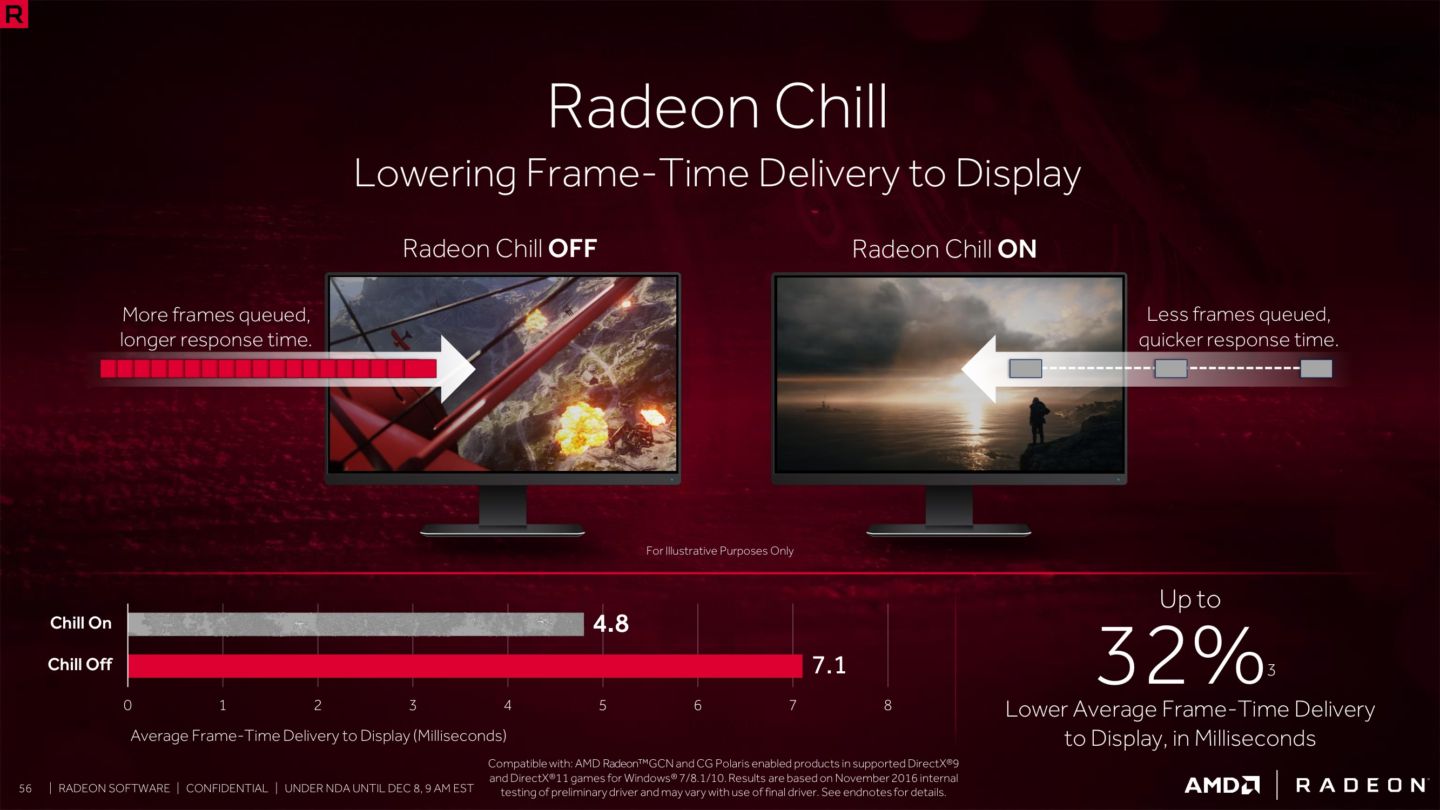
Time for real world testing.
TechReport did just that and noticed frame times with Chill enabled were occasionally faster than with Chill disabled.
During periods of low user interaction or little action on screen the CPU and GPU power limit is reduced, causing the hardware to slow down ... one side-effect of this means that fewer frames are queued in the buffer, which AMD claims it results in a quicker response time from frame generation to frame output.Reducing CPU power means that any ramp up from the slower state will have to be very fast in order to ensure no latency from increased CPU time. Absent hardware based frequency shifting, which is the case for pre-Skylake Intel CPUs, this can take up to 100ms although the time is typically closer to 20ms. So that's at least on or two frames depending of input lag depending on refresh rate. And aren't the frame queues around 3 at most? Or is that OpenGL only? Or was that VSync and triple buffering?
Time for real world testing.
TechReport did just that and noticed frame times with Chill enabled were occasionally faster than with Chill disabled.
That result does seem to mesh with AMD's claim that Chill can improve responsiveness by keeping more of the GPU available for times when fast rendering in response to user input is needed.But that might just be part of the story. The real test will require the mice + led switch and high frame rate capture analysis. Paging systema.
Tuesday, December 13, 2016
Ryzen ... and that 6700K 4.5 test
Just watched the AMD Zen stream and of course the most telling information was what was not revealed. There was no word on price, frequencies, or single threaded performance. Not revealing the price is understandable but no information on upper frequencies or single threaded performance is unfortunate.
Intel's foundries are better so it's hard to imagine Ryzen matching the frequencies Intel is able to achieve. However, the 95W TDP for their 8 core part is a good sign. Then again, if that is 95W of AMD TDP, then I'm not so sure. If the scaling is anything like the FX series, then 4.7GHz base is going to be 220W which would be pretty good considering these are 8 full cores with better IPC. Even if it's higher, either way it's watercooling territory.
Single threaded performance is almost certainly worse or else AMD would have been demonstrating a lot more benchmarks apart from Blender where IPC appears about the same. Worst case? Bulldozer scenario where AMD cherry picked a few benchmarks to show parity or superiority to Intel's CPUs but underperformed in the real world.
I don't think this is the case with Zen. The Blender and x264 tests (Handbrake and Twitch) were a really good showing not only over AMDs previous micro-architectures but also versus Intel's latest. Maybe the x264 improvements are just the result of better AVX support and Blender is a one-off? Please no.
But the most controversial moment in the stream was the demo of the 6700K @ 4.5GHz versus Ryzen.
Most comments thought there was some rigging involved since the 6700K stream/gameplay looked like a slideshow. I don't think so. The streaming settings were almost certainly at a higher quality x264 preset or resolution/fps. Each step in x264 quality/resolution/fps requires a large increase in CPU power so it is easy to bog down any given setup this way.*
No one with a 4.5GHz 6700K is streaming a CPU intensive game using 1080p60 @ medium whereas that's probably doable with the 8-core 6900K or Ryzen. So yeah the demo was rigged in the sense that streamers are not going to use settings where gameplay and stream quality are trash but it isn't rigged in the sense that the 6900K or Ryzen are going to be able to offer better quality streams even against the best mainstream Intel CPU.
But that 6700K is still going to offer better gaming framerates when not using x264. And you get the best of both worlds with a dual PC streaming setup anyway. Ryzen would be a great candidate for a streaming PC though.
Anyway, Zen seems to be as or slightly better than expected but not what a lot of us were hoping for. Its success will depend on release prices and process improvements to improve frequencies. AMD needs to offer Ryzen at a much lower price than the 6900K to compensate for its likely worse frequency and somewhat lower likely IPC across most programs. None of that $900 FX9590 nonsense.
* Stream quality increases can be done granularly with fps but less so with resolution and x264 quality.
Intel's foundries are better so it's hard to imagine Ryzen matching the frequencies Intel is able to achieve. However, the 95W TDP for their 8 core part is a good sign. Then again, if that is 95W of AMD TDP, then I'm not so sure. If the scaling is anything like the FX series, then 4.7GHz base is going to be 220W which would be pretty good considering these are 8 full cores with better IPC. Even if it's higher, either way it's watercooling territory.
Single threaded performance is almost certainly worse or else AMD would have been demonstrating a lot more benchmarks apart from Blender where IPC appears about the same. Worst case? Bulldozer scenario where AMD cherry picked a few benchmarks to show parity or superiority to Intel's CPUs but underperformed in the real world.
I don't think this is the case with Zen. The Blender and x264 tests (Handbrake and Twitch) were a really good showing not only over AMDs previous micro-architectures but also versus Intel's latest. Maybe the x264 improvements are just the result of better AVX support and Blender is a one-off? Please no.
But the most controversial moment in the stream was the demo of the 6700K @ 4.5GHz versus Ryzen.
Most comments thought there was some rigging involved since the 6700K stream/gameplay looked like a slideshow. I don't think so. The streaming settings were almost certainly at a higher quality x264 preset or resolution/fps. Each step in x264 quality/resolution/fps requires a large increase in CPU power so it is easy to bog down any given setup this way.*
No one with a 4.5GHz 6700K is streaming a CPU intensive game using 1080p60 @ medium whereas that's probably doable with the 8-core 6900K or Ryzen. So yeah the demo was rigged in the sense that streamers are not going to use settings where gameplay and stream quality are trash but it isn't rigged in the sense that the 6900K or Ryzen are going to be able to offer better quality streams even against the best mainstream Intel CPU.
But that 6700K is still going to offer better gaming framerates when not using x264. And you get the best of both worlds with a dual PC streaming setup anyway. Ryzen would be a great candidate for a streaming PC though.
Anyway, Zen seems to be as or slightly better than expected but not what a lot of us were hoping for. Its success will depend on release prices and process improvements to improve frequencies. AMD needs to offer Ryzen at a much lower price than the 6900K to compensate for its likely worse frequency and somewhat lower likely IPC across most programs. None of that $900 FX9590 nonsense.
* Stream quality increases can be done granularly with fps but less so with resolution and x264 quality.
Thursday, November 24, 2016
Happy Thanksgiving!
If you are reading this, then you probably have a computer or smartphone, electricity, shelter, food, and all kinds of things that make living in the 21st century a lot nicer than most of the other centuries.*
There'd be a lot more to be thankful for, though, if you had your computer or smartphone just twenty years ago when the whole world would have completely dumbfounded by it. In fact, the government probably would have had your computer or smartphone confiscated in the name of national security so I guess you'd be less thankful for that.
In 1996, people still had dialup internet and a power user 0.2GHz Windows machine set you back $5,000 (almost $8,000 in 2016 dollars).


* Or maybe you don't have any of those things and are a homeless guy reading this at a library but if I were homeless I would be loading up on turkey at the local shelter since Thanksgiving is one of the few days when society shifts focus somewhat toward the less fortunate.
** He bought into the fast life and lost it all.
*** Low input lag, firmware configured settings, durable finish, easy to clean, custom ergonomics, no sensor issues like angle snapping or acceleration, repairability, quiet clicks. As a lefty, my choices are sharply curtailed and I'm using the Logitech G900 after having gone through two faulty Logitech mice and the infuriating Razer software. The G900 hits most marks but: isn't easy to clean, its finish is starting to wear, probably difficult to repair, and sounds like a nail clipper with every click.
**** Yeah, couldn't help taking a swipe at Krugman and his Keynesian buddies but I can't help feeling perversely thankful for the Establishment getting taken down several notches this election year. They haven't given up (and why would they? The odds favor the house at the end) but if the corporate tax rate is reduced to 15%, that will provide favorable conditions for entrepreneurship – the key reason we have all these things to be thankful for in the first place.
There'd be a lot more to be thankful for, though, if you had your computer or smartphone just twenty years ago when the whole world would have completely dumbfounded by it. In fact, the government probably would have had your computer or smartphone confiscated in the name of national security so I guess you'd be less thankful for that.
In 1996, people still had dialup internet and a power user 0.2GHz Windows machine set you back $5,000 (almost $8,000 in 2016 dollars).

At the time, this got my heart racing
Flipping through the August 1996 issue of Boot magazine shows how far we've come but also a bit of what we've lost. It might have been part of an unsustainable tech bubble brought down by the prosaic realities of the Business Cycle, but at least we got these fevered dreams of the future. Cyberpunk, virtual reality, Skynet. There's little to be thankful about our current asset bubble. I suppose we've traded away some future prosperity to prop up the deteriorating grandeur of McMansion America.
Even then, I think about my great uncle who was a top flight lawyer back in the Philippines. He had a car and a refrigerator back in the 1930s. That was high living even by American standards so you can imagine how impressive it was in the Philippines.** No one brags about owning a refrigerator today.
Even the first generation iPhone obliterates 1996's Dream Machine once you add in speakers, monitor, and input devices. This is why buying high quality peripherals makes more sense than buying faster hardware. Now if only someone would make a good mouse.***
Apart from IT advances, life in 1996 was largely the same and I'd still be thankful for many of the same reasons so it gets old. You're never really thankful until you no longer have those things. And in an age of increasing abundance, the potential of losing it all becomes rarer.
Less than a century ago, around 30% of Americans were farmers. Being thankful for a good harvest was near universal and that sense of privation and bounty were a natural incentive to the formation of good people. Voluntary privation, whether it's fasting or cutting back or even going camping are ways to bring that sort of character building back. There's some sense of that in Survivor or disaster themed shows which, at least personally, is part of their appeal; though, I would never wish disaster on civilization just to make people feel thankful later on – let alone for the economically dubious reason of increasing demand to help the economy. 😆😆😆****
I really, really, really, like the face with tears of joy emoji but Microsoft's version is poorly done (😂??) so here's a superior version I found online.

* Or maybe you don't have any of those things and are a homeless guy reading this at a library but if I were homeless I would be loading up on turkey at the local shelter since Thanksgiving is one of the few days when society shifts focus somewhat toward the less fortunate.
** He bought into the fast life and lost it all.
*** Low input lag, firmware configured settings, durable finish, easy to clean, custom ergonomics, no sensor issues like angle snapping or acceleration, repairability, quiet clicks. As a lefty, my choices are sharply curtailed and I'm using the Logitech G900 after having gone through two faulty Logitech mice and the infuriating Razer software. The G900 hits most marks but: isn't easy to clean, its finish is starting to wear, probably difficult to repair, and sounds like a nail clipper with every click.
**** Yeah, couldn't help taking a swipe at Krugman and his Keynesian buddies but I can't help feeling perversely thankful for the Establishment getting taken down several notches this election year. They haven't given up (and why would they? The odds favor the house at the end) but if the corporate tax rate is reduced to 15%, that will provide favorable conditions for entrepreneurship – the key reason we have all these things to be thankful for in the first place.
Tuesday, November 15, 2016
Methodology done RIGHT
"Pick your battles"Some battles are a lost cause. Decimate is beyond saving. The historically specific meaning about the Roman practice will probably stick around in specialized discussion, but the proper general meaning of "a 10% loss" isn't coming back.
The same is probably true of methodology and problematic. I only complain about these because I see them used incorrectly all the time. I'm being a hypocrite here because I am a bad writer wont to begin sentences with "and", intentionally use sentence fragments, on top of all kinds of other writing mistakes.
But a tech article this morning got it half right, and that ain't bad. The writer still conflates method and methodology here:
I've been working behind the scenes on a radically new test methodology.Yet what follows is a discussion of why he believes some methods are better than others, and why a particular method was chosen for his review. In other words, actual methodology. This made me very happy! The article is a review of the Samsung 960 EVO SSD which is of limited interest, but within his methodological discussion is this gem
Analyzing trace captures of live systems revealed *very* low Queue Depth (QD) under even the most demanding power-user scenarios, which means some of these more realistic values are not going to turn in the same high queue depth ‘max’ figures seen in saturation testing. I’ve looked all over, and nothing outside of benchmarks maxes out the queue. Ever. The vast majority of applications never exceed QD=1, and most are not even capable of multi-threaded disk IO. Games typically allocate a single thread for background level loads. For the vast majority of scenarios, the only way to exceed QD=1 is to have multiple applications hitting the disk at the same time, but even then it is less likely that those multiple processes will be completely saturating a read or write thread simultaneously, meaning the SSD is *still* not exceeding QD=1 most of the time.I will admit to confirmation bias here since I've long believed QD1 to be the most important SSD metric. And until developers start paying attention to multi-threaded disk IO, QD1 will remain important in much the same way CPU frequency and memory latency are generally more important than CPU cores or memory bandwidth.
* Ironically, people who think the incorrect use of decimate should be acceptable like to defend their illogical view by accusing their opponents of employing the rather logical sounding etymological fallacy, which, Wikipedia tells me, is a species of genetic fallacy.
But these sorts of fallacies are informal ones, i.e., undeserving of sharing even part of the certitude that "fallacy" conveys in formal logic.
Wednesday, November 9, 2016
Things to look forward to in 2017
Thankfully the election is over! For the amount of time people, myself included, devote to this thing, the actual impact the president has on most people's lives is very low. Ask yourself how Obama's eight years have affect you personally. Me? I've had to pay fines for not having health insurance. Thanks Obama.
But here are some cool things that will probably have more effect on my life (and maybe yours too if you are a filthy computer nerd) next year than the president ever will! That is, unless the Draft is called; one reason to prefer candidates who want isolation peace.
OLED displays
eBay was running a deal for a 55" 4K OLED TV for $1500 a few days ago. So I think that's a sign of things to come. Back in 2008 I was predicting that OLED prices would quickly drop from the stratospheric $2,500 Sony was asking for an eleven inch OLED TV and dominate the display market by 2010 with cheap, huge, flexible screens.
Boy was I wrong. But these things are finally getting cheap and are the very-best-like-no-one-ever-was of display technologies. The deepest blacks, super low persistence, outstanding viewing angles and colors. TN, IPS, VA, and even Plasma/CRT, have too many compromises that OLED takes care of. OLED might degrade faster than other technologies and use more power in some situations, but it's a small price to pay for picture and motion quality supremacy. As a parenthetical, even though OLED is capable of very high brightness, I'm not sure how well that brightness holds up in low persistence modes, e.g., most strobing monitors have drastically lower brightness in strobe mode although EIZO seems to have figured out a way to mitigate the issue with its Foris monitors.
Overclocking
Intel got a bit of its OC groove back with the Haswell Refresh, but this years Skylake and next year's Kaby Lake look to be a firm step back to good overclocks. The mainstream Haswell i7 averaged about 4.47GHz whereas Refresh and Skylake average 4.65GHz on air.
Kaby Lake is clocking in 4.2GHz stock turbo boost frequencies so I'm really hoping 5GHz chips become a regular feature on Silicon Lottery.
Speaking of which, Silicon Lottery now offers delidding for the i7-E CPUs (which already use a higher quality TIM, i.e., Thermal Interface Material) than the normal i7. The thermal advantage isn't as large as say, delidding a 4770k, but it looks to be nearly 10C. Impressive! I don't know about the price, but removing the solder-based TIM from an enthusiast i7 is a lot more involved. It's still worth it, I think, given how long we are holding on to CPUs these days.
An easier route to get cooler temps? More people are experimenting with cooling the underside of the processor with basic heatpads, heatsinks, and fans. It should be fairly simple and inexpensive while offering several degrees of additional cooling. It makes a lot more sense for motherboard and case manufacturers to accommodate this rather than put features geared towards LN cooling and external radiator setups on power user products.
Alphacool has developed a replacement for the venerable D5 pump which promises to offer the same performance with lower noise and vibration.** Pump noise drives me nuts and is one of the two things I hate about watercooling. Maintenance is the other, though now that the All-In-One (AIO) units are getting really good; if Alphacool creates a premade AIO with this new pump, it'll go into my next build. It might just be on par with the D5 so this sounds like a job for SilentPCReview.
Intel's fancy new Turbo Boost 3 (TB3) seems to be a way to realize gains from per-core overclocking. Right now it's only on their latest i7-E chips, but that's where it makes the most sense. Usually, as you add CPU cores, the top frequency drops because people usually limit their overclocks to the weakest core. This is because it's not only easier to test all the cores at the same time for stability but it's a pain to make sure the different required voltages are supplied properly and make sure that core affinities are set optimally. Even with core affinity automation software like Process Lasso, I read somewhere that a given core assignment doesn't always correspond to the same physical core.
TB3 fixes that by uniquely identifying each core according to their quality and automatically assigning the most intensive threads appropriately. In theory, that means that buying a processor with more cores should mean a higher top frequency because the chances of getting a golden core improve with more cores.
But my experience with Intel's software has been just wait for the next version – if there is a next version. Step in the right direction though.***
Caching Hardware
The Integrated Memory Controller (IMC) on Intel's chips seems to have been refined bigly with Skylake. It's still the silicon lottery with both processor and RAM, but Silicon Lottery also tests IMC strength – for a price.
Speaking of RAM, 2016 saw the widespread adoption of Samsung's high performance B-die in DDR4 sticks. Perfect for the beefier Skylake IMCs (though a quality motherboard is also required to achieve good overclocks). Synergy.
Optane should be hitting the market in 2017 along with appropriate supporting hardware. It's meant to be much faster than SSDs though early benchmarks give me the suspicion that this is might end up RAMBUS-tier. But if it can deliver the low queue depth 4K goods, then sign me up. If not, Samsung's recently released 960 Pro should be on the short list of any 2017 build. Unlike most SSDs, some kind of extra cooling is needed to keep the 960 Pro (and its OEM predecessor SM961) from thermal throttling, something I take perverse delight in.
AMD Zen
Zen is probably not going to be as fast as Intel's best. So 2017 will probably see the prices on Intel and nVIDIA's flagships creep up. Most people don't buy the top of the line CPU or GPU, but competition at the top means fiercer price competition at all levels. If AMD can produce a $1000 10-core CPU that outperforms Intel's $1700 10 core CPU, not only does Intel's 10 core CPU price get slashed to around $1000, but it also means Intel's $1000 8 core CPU gets a price reduction and so on.
Hope springs eternal, but maybe it's a return to Athlon form. Zen, like Athlon, is an elegant architecture name. Note to AMD, names like: Hammer, Bulldozer, Piledriver, and Sledgehammer, don't really make sense if the product performs worse than the competition. I don't know what I'm going on about but I do know what I want. And that is ... for Jim Keller to Make. AMD. Great. Again.^
1080Ti
Pretty sure Jim Keller's pixie dust didn't land on the ATI team so I Vega 10 is probably going to be a bust. It might be a good product but I think nVIDIA has already telegraphed, via locked voltages on its newest cards, an intention to drop a slightly weaker Titan Pascal with whatever clocks are necessary to beat Vega 10. Even if Vega 10 wins in DX12 performance, that (still) won't be relevant in 2017. On the other hand, ATI vs nVIDIA seems to have had a lot more back and forth than AMD vs Intel.
VR
All indications are that Sony's PS4 VR is a great product and the Chinese are going to have their Vive/Rift clones out soon which will be good for everyone. The physical and spatial aspects that VR adds could be a powerful adjunct to meditation and learning. It's the Wild West out here and it's wonderful.
End notes:
** Aquarium filter manufacturers are you listening?
*** Intel has this legendary reputation in hardware that makes its software shortcomings hysterical. On reflection, Intel hasn't been infallible at all but there's this kind of reverence computer people have toward the company. Like pre-2008 Greenspan.
^ I know he left but writing "Jim Keller to have 'Made AMD Great Again'" is awkward
Tuesday, November 8, 2016
Gaming the vote
A few weeks after I send in my ballot, the election commission sends me a letter asking me to update my signature. It's apparently changed from the time I registered. The only time I'd bother to update that signature is in the Nozickian situation where my vote actually did count, i.e., I am the tie-breaker.
Statistically, it's unlikely.
But is the statistical unlikelihood of being the tie-breaker a mathematically compelling argument against voting? I have my doubts. Everyone else is a potential tie-breaker and so the correct strategy is for no one to vote. But as the number of voters go down – assuming a homogeneous reduction – the likelihood of being the tie-breaker goes up.
What about a heterogeneous reduction in the numbers of voters? If it wasn't obvious, the decision of whether to vote has some Prisoner's Dilemma type aspects. Deciding to vote carries with it a burden of having to pay at least some attention to political ads, arguments, and all the other things that make the election season wearying.
Imagine two Nozickian voters on opposite sides, Red versus Blue. If Red votes but Blue does not, Red wins and vice-versa. If both vote, it's a tie but both will have wasted time and money in the process. If neither vote, neither will have wasted time and money. The stable "intelligent" choice is to not vote. But if the policy differences appear large enough, the payoff for coöperating becomes insignificant.
If this election's presidential contest were between The Apprentice Trump and First Lady Clinton, no one would vote. But when it's between Literally Hitler Trump and In Your Heart You Know She Might Clinton, the payoff is tantamount to saving the world. We saw this earlier with Brexit where I could not understand the hysteria over a largely inconsequential vote.
Although Trump is definitely the non-establishment protest figure in the election (and the candidate I would expect to win), neither offer anything radically different*. So the stable intelligent choice is still to not vote. However, if there is a meaningful difference in intelligence between Red and Blue, then the stable intelligent choice becomes unlikely because less intelligent people are less coöperative. Thus, given unequally intelligent players, the correct strategy is to vote even if the outcome is almost guaranteed to be less than optimal.
* Principled to the point of consistency. The only believable differences are a stricter immigration policy and lower corporate taxes on Trump's part.
Statistically, it's unlikely.
But is the statistical unlikelihood of being the tie-breaker a mathematically compelling argument against voting? I have my doubts. Everyone else is a potential tie-breaker and so the correct strategy is for no one to vote. But as the number of voters go down – assuming a homogeneous reduction – the likelihood of being the tie-breaker goes up.
What about a heterogeneous reduction in the numbers of voters? If it wasn't obvious, the decision of whether to vote has some Prisoner's Dilemma type aspects. Deciding to vote carries with it a burden of having to pay at least some attention to political ads, arguments, and all the other things that make the election season wearying.
Imagine two Nozickian voters on opposite sides, Red versus Blue. If Red votes but Blue does not, Red wins and vice-versa. If both vote, it's a tie but both will have wasted time and money in the process. If neither vote, neither will have wasted time and money. The stable "intelligent" choice is to not vote. But if the policy differences appear large enough, the payoff for coöperating becomes insignificant.
If this election's presidential contest were between The Apprentice Trump and First Lady Clinton, no one would vote. But when it's between Literally Hitler Trump and In Your Heart You Know She Might Clinton, the payoff is tantamount to saving the world. We saw this earlier with Brexit where I could not understand the hysteria over a largely inconsequential vote.
Although Trump is definitely the non-establishment protest figure in the election (and the candidate I would expect to win), neither offer anything radically different*. So the stable intelligent choice is still to not vote. However, if there is a meaningful difference in intelligence between Red and Blue, then the stable intelligent choice becomes unlikely because less intelligent people are less coöperative. Thus, given unequally intelligent players, the correct strategy is to vote even if the outcome is almost guaranteed to be less than optimal.
* Principled to the point of consistency. The only believable differences are a stricter immigration policy and lower corporate taxes on Trump's part.
Monday, October 31, 2016
Poetry
Completely unintentional but when I noticed, I just had to take a screenshot. I figured today would be a good day to share it. R U SPOOKED?

Wednesday, October 26, 2016
Tired are your splendid soldiers – To the future turned, we stand!
Just finished the third season of Black Mirror, a hip, smart, and modern* take on the Twilight Zone/Outer Limits. American adaptations of foreign programs often lose a lot in translation, but Netflix has done a great job of keeping the general feel of the British originals, e.g., minimalist pastel aesthetics, slow-motion-backed-by-ostinato-soundtrack sequences, etc.** while integrating certain themes unique to the American milieu.
It's got technological alienation and dehumanization, The Singularity, emulated minds, big data, social media, law, politics, AI, robotics, augmented/virtual reality! It fills a niche that has been empty since Star Trek: The Next Generation (sorry, Fringe doesn't count). It's all there. Almost.
However, the dystopian outlook towards technology is predictable. This series really could have used input from someone like Robin Hanson to provide depth. Not balance, but depth; though, a portrayal of the genuine benefits of future technology would go some way to providing that depth.
* I.e., ticks all the focus group approved boxes
** Broadchurch also did this. Maybe it's a British thing.
It's got technological alienation and dehumanization, The Singularity, emulated minds, big data, social media, law, politics, AI, robotics, augmented/virtual reality! It fills a niche that has been empty since Star Trek: The Next Generation (sorry, Fringe doesn't count). It's all there. Almost.
However, the dystopian outlook towards technology is predictable. This series really could have used input from someone like Robin Hanson to provide depth. Not balance, but depth; though, a portrayal of the genuine benefits of future technology would go some way to providing that depth.
* I.e., ticks all the focus group approved boxes
** Broadchurch also did this. Maybe it's a British thing.
Monday, October 17, 2016
Imperium Mendaciorum
I like NPR, or at least I used to when I was growing up. There was a lot of unique reporting that you couldn't find anywhere – stuff like flute making in Kazakhstan.
"We're here in a remote village on the outskirts of Astana, Kazakhstan with Kiril Kurobayev. [market chatter, distant muezzin, pots clanking] Kiril lives with his wife and three children and extended family ... [Kazakh dialogue fading to translator]"
Basically a science fiction short story, except it was real. The previous excerpt wasn't real; I just made that up for effect. Now NPR mostly pushes a hard left line. Not that it wasn't always leftist; it was. But it wasn't always so overt.* That used to be the style of right-wing radio. Good ol' right-wing talk radio. Entertaining in its own way. NPR might report about the four trillion dollar National Debt (under Bill Clinton), but Rush Limbaugh could make you get mad about how high it was getting.
Twenty years later, NPR is doing its best to make you mad about not increasing the National Debt past the nineteen trillion or so it is now. And the methods that NPR and the normally left-leaning media use are veering away from their older dispassionate stance towards emotional "win at all costs" propaganda. This bit of insight from a recent Intelligence Squared debate.
Ben Domenech:
... the things that were printed about Mitt Romney in 2012 in the New York Times by Paul Krugman called him a "charlatan," "pathologically dishonest," "untrustworthy." He said he didn't even pretend to care about poor people, that he wants people to die so that rich people get richer. "He's completely amoral, a dangerous fool, ignorant as well as uncaring."
Male Speaker:
Sounds familiar.
[Laughter]
Ben Domenech:That's Paul Krugman, Nobel Prize winner in economics writing in the most prestigious newspaper in the US and possibly the world! I don't know if the WSJ said similar things about Obama, though I wouldn't be surprised.
If you cry wolf long enough, sometimes the beast actually shows up, okay?
And when that happens, they no longer had a vocabulary that could be used, because everyone tunes them out and says, "Well, you were saying that about this nice Mormon businessman, you know, four years ago."
But I'd be doubly unsurprised if Wikileaks showed active collusion between Krugman and the Obama campaign the same way the recent Wikileaks releases of the Podesta e-mails show the New York Times (et al) and even the Justice Department colluding with Democratic Party hierarchs to help Hillary Clinton.
It's not all bad since these releases presumably contain the truth, or at least what people really think is the truth. I'd go for a jab about private versus public convictions, but I don't think it's a big deal. It's even SOP in Japan and probably most European countries too. Except France, judging by the etymology of frank.
Most interestingly, the releases support a hunch I've had regarding our economic health. Things are worse than the headline figures suggest and that labor participation rates, contrary to what Matt Phillips over at Quartz believes, support this idea. But I'll spend some time showing why he's wrong in greater depth later.
* About the only NPR program worth listening to these days is Goats and Soda.
Also, why have the TED talks gone from introducing the public to genuine innovation and novel insights to vapid vaguely leftist pop-psychology? Everything else gets dumbed down so you'd expect the niche that the TED talks provide to flourish.
Wednesday, September 21, 2016
Windows 10 (is) for Dummies
So I get on my computer and Windows has decided to update itself unilaterally. It wouldn't be so bad if it restored the state of my desktop instead of resetting it - i.e. the equivalent of a janitor completely clearing your desk so you have no idea where you left off when you come back to work in the morning. More than that, this "Anniversary" edition update also reset my desktop background.
Why? I know it's simple to restore but if Microsoft couldn't get that detail right, who knows what else they might have broken under the hood. It's the sort of thing that makes me want to reformat. But I'd still reinstall with Windows 10 because Windows 7 is no longer supported and Windows 8 will no longer have support in a few months. Similarly, software developers are now mostly working in a Windows 10 environment which means higher compatibility and lower risk for end users using Windows 10.
It's not all bad. With Windows 10, when I click on a file and press delete, it no longer asks whether I really want to send the file to the Recycle Bin. I can also have variable window sizes and have Windows automatically resize another window to fit the remaining desktop space. I'm sure those were possible in previous versions, but any improvement to default behavior is welcome. There's also DirectX 12, but by the time that becomes relevant, there will probably be a new version of Windows out.
Does that outweigh the increased telemetry and obnoxious update behavior of Windows 10? Privacy and a predictable user experience are important to me so if Microsoft - and Google - continue as they have been, I'm seeing Linux and Blackberry in my future.
The computing environment when I was growing up was basically: programs do not do anything without your permission. Rebooting my computer without my permission and sending info about how I write to the oh-so secure and reliable cloud is something that used to be called malware.
Wednesday, August 3, 2016
Two Studies Walk Into a Journal
The first study finds that being overweight does not increase the odds of a heart attack or death. The second study finds people who get their protein from animal sources are more likely to get a heart attack or die.
The first study was based on observations from identical twins* whereas the second isworthless based on food questionnaires and follow ups. But, there's little doubt which will win the mindshare battle. The former I read about in an extremist crank's blog whereas I was made aware of the study about beans and tofu being superior through a fashionable technology blog; I can already hear the NPR segment and see the fluff piece in a checkout stand magazine and Reddit post "source".
As a former science teacher, I've come to regret the popularization of science which has resulted in a dumbing down of science rather than improving the scientific literacy of the interested population. On first glance, I figured that a more approachable and entertaining look at concepts could only be for the better but I now believe that in the long run, the fun Vsauce-style approach enervates rigor.**
* Identical twin studies ought to be the baseline for any epidemiological study. Studies based on questionnaires are literal trash.
** This despite what The Atlantic suggests regarding the popular channel. But The Atlantic has also been garbage for the past few years so no surprise. I resubscribe every now and then hoping it's stopped, or slowed, the grinding of its ideological axe. But no. America's balkanization is real. Inevitable.
The first study was based on observations from identical twins* whereas the second is
As a former science teacher, I've come to regret the popularization of science which has resulted in a dumbing down of science rather than improving the scientific literacy of the interested population. On first glance, I figured that a more approachable and entertaining look at concepts could only be for the better but I now believe that in the long run, the fun Vsauce-style approach enervates rigor.**
* Identical twin studies ought to be the baseline for any epidemiological study. Studies based on questionnaires are literal trash.
** This despite what The Atlantic suggests regarding the popular channel. But The Atlantic has also been garbage for the past few years so no surprise. I resubscribe every now and then hoping it's stopped, or slowed, the grinding of its ideological axe. But no. America's balkanization is real. Inevitable.
Subscribe to:
Posts (Atom)